Meet bridgit ! Your new data juggling assistant to share important research data.

Let us introduce you two.
Think of bridgit as your new, multitasking research partner. The app will support you from the very first draft of your dataset to publishing it with the scientific community - bridgit accompanies you step by step without compromising any of your effort. And the best part? bridgit is fully integrated into your secure university cloud environment, making sharing easy and safe.
bridgit emerged from a DFG-funded project and is administrated by the University of Münster, with the University of Potsdam as its scientific consultant. The collaboration has been so successful that bridgit was piloted in the sciebo Hochschulcloud at the University of Münster, where it proved its value in real-world academic settings and quickly began attracting the interest of other institutions.
Why share your research data at all?
We are working together - for the bigger picture.
Open science drives transparency, collaboration, and innovation in research. By making data accessible, interoperable, and reusable, the FAIR (Findable, Accessible, Interoperable, Reusable) principles ensure that research outputs can be discovered, shared, and built upon by the entire research community¹.
How does bridgit work exactly?
One word: easy. Another one: integrated into everyone’s workflow.
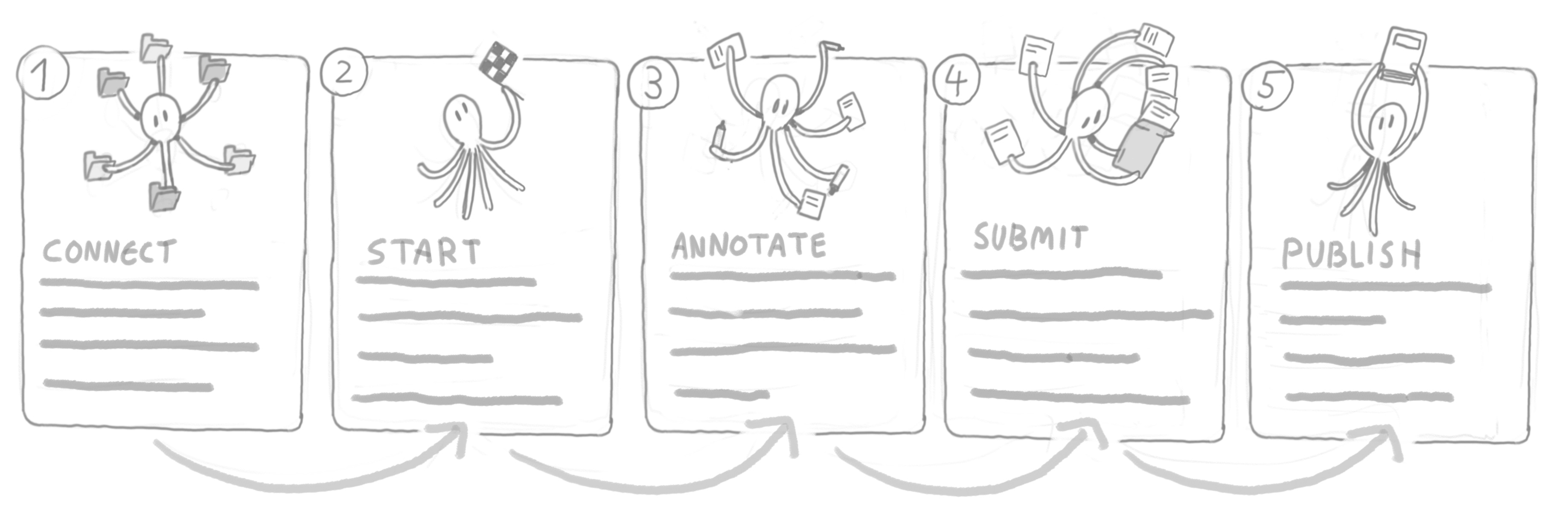
bridgit supports you from the very first step of preparing and saving your data through to securely sharing it with the scientific community. All without compromising your control or exposing your data to the risk of misuse. Integrated directly into your secure university cloud, bridgit turns data management into a seamless part of your research routine.
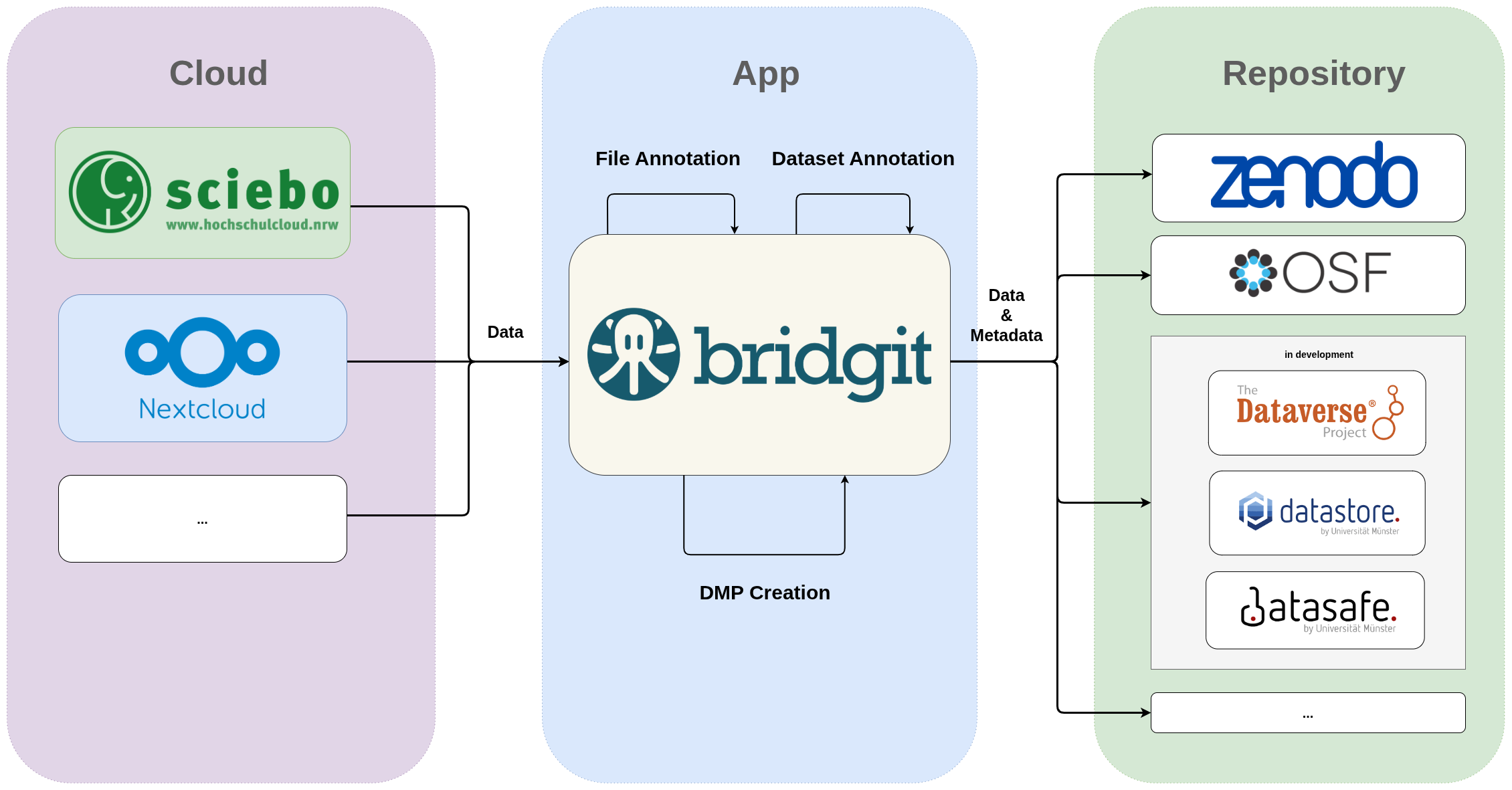
bridgit enables you to:
- prepare and annotate datasets
- write and maintain data management plans
- upload projects, data objects, and metadata annotations
- connect directly with external research data services such as Zenodo or OSF to upload your data directly into the repositories
Who benefits from using bridgit?
First and formost: The entire science community!
But specifically, bridgit is mainly designed for three main groups: researchers across all disciplines at universities and institutes who need secure data management, academic institutions who want to extend their (e.g.) Nextcloud environment with a research-focused solution and non-academic companies who are interested in integrating or extending bridgit to meet specific organizational needs (or connect their work to the scientific community).
Beta testing
We invite you to join the bridgit beta test! As early adopters, you'll have the chance to use the app before its official release. Your feedback is invaluable. Whether you're working on a dataset now or will do so in the future, we encourage you to test the app and provide your thoughts.
¹ Wilkinson, M., Dumontier, M., Aalbersberg, I. et al. The FAIR Guiding Principles for scientific data management and stewardship. Sci Data 3